Further contributions

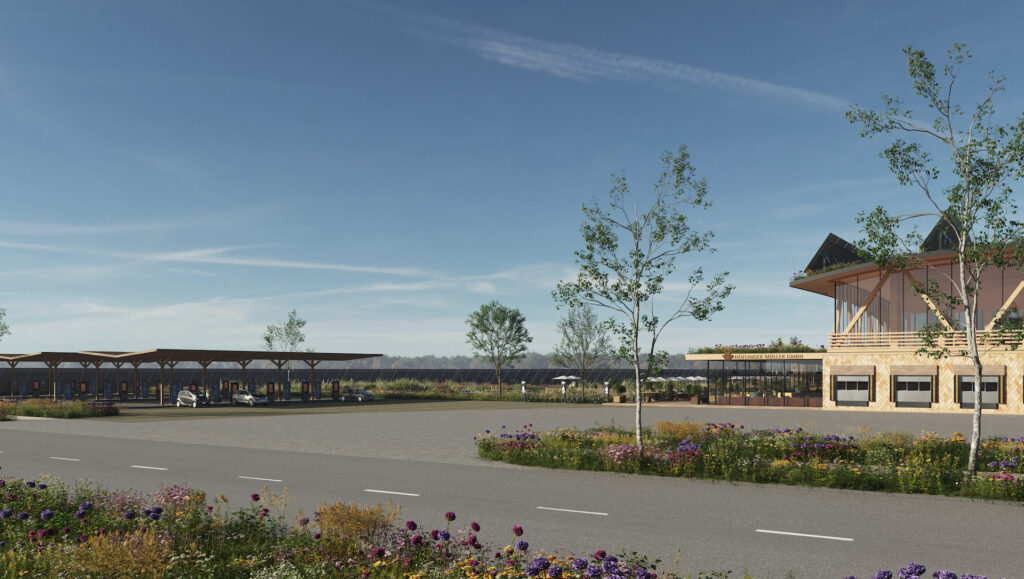
A photovoltaic park is to be built on an area of around 35 hectares in the immediate vicinity of the Munich Airport Business Park in Hallbergmoos between the B301 federal highway and the S-Bahn line to Munich Airport. 37 million kilowatt hours of electricity could be produced here – as much as Hallbergmoos currently consumes. The photovoltaic lighthouse project will drive forward the energy transition in Hallbergmoos. The declared goal: a CO2 saving of 20,000 tons per year. However, the project partners Energieallianz Bayern and Höflinger Müller GmbH are going one step further. As an adventure park, the entire area is to offer several added values: Green electricity for households and businesses in Hallbergmoos, but also a better quality of stay for visitors. In an interview, we asked Ulrich Geis, Managing Director of Energieallianz Bayern, about the specific plans.

Ulrich Geis: “Almost 100 people attended the public information event in the community hall of Hallbergmoos. The many questions and positive response have shown us: There is a great deal of interest and approval for the energy transition in Hallbergmoos.
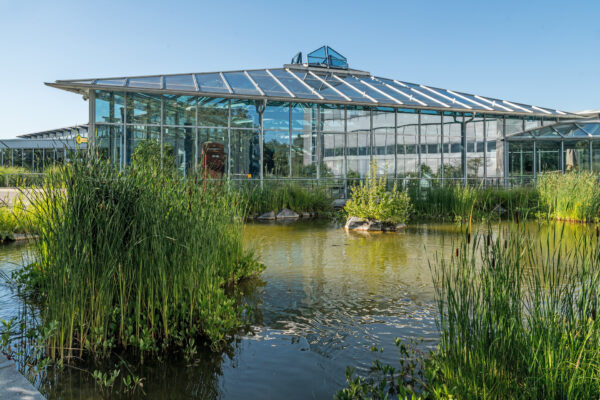
Geis: Correct. Energieallianz Bayern is an association of Bavarian municipal utilities. Our goal is to drive forward the energy transition in municipal hands. To this end, we plan, build and operate renewable generation plants, with a focus on wind and photovoltaics. Also in Hallbergmoos. Here, however, we are going one step further than before: together with our project partner Höflinger Müller, we are not only implementing a huge photovoltaic system in Hallbergmoos. The concept also includes a service station with its own fleet of e-trucks, a gastronomic experience, an e-filling station and a natural pond.
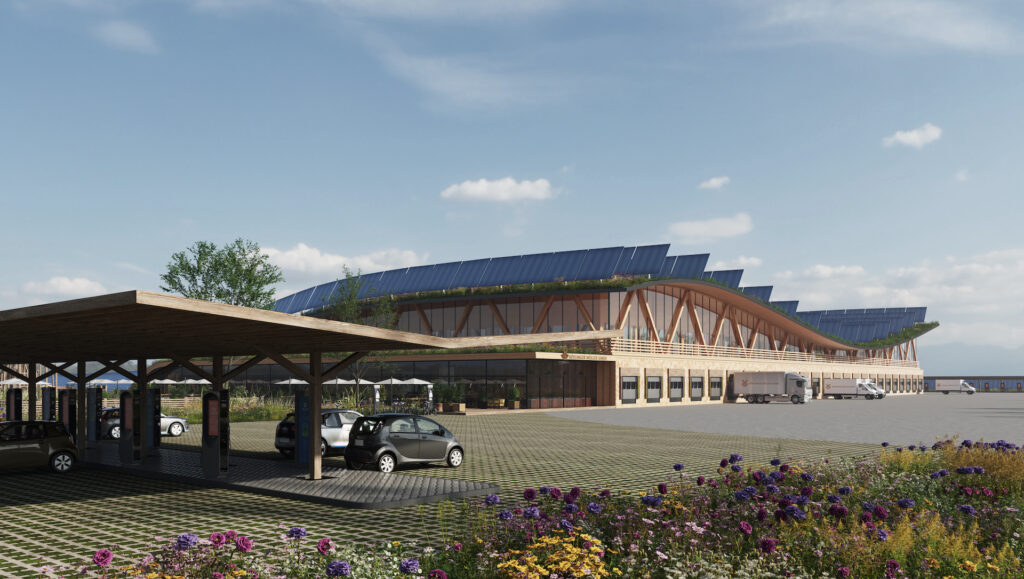
Geis: Above all, sustainable electricity. But also significantly more quality of stay and environmental protection. Thanks to the gastronomic concept, the natural pond and the bee- and insect-friendly photovoltaic park, residents, visitors and nature will benefit equally from the project. Of the 37 million kilowatt hours of electricity to be produced, 10 percent will be consumed on site. One of the main reasons for this is Höflinger Müller’s cold store. However, it is only cooled during the day. No cooling capacity is required at night. The remaining 90 percent of the electricity produced is sufficient for 10,000 households and businesses in Hallbergmoos. This could make the municipalityCO2-neutral in one fell swoop!
Geis: The e-truck fleet will make a significant contribution to solving the problem. Keyword: bidirectional charging. We not only want to charge the trucks, but also use the batteries as storage. Up to 400 kilowatt hours of electricity can be stored per truck. The trucks will be charged during the day and the electricity will be used at night. We are currently in talks with well-known manufacturers of electric trucks to implement this.
Geis: The energy transition is an acute issue. Not only in Hallbergmoos. But there were many factors that spoke in favor of implementing the photovoltaic project here: We have a plot of land that is restricted by traffic routes and has good connections for this very reason. In addition, the municipality of Hallbergmoos was very cooperative right from the start and once again proved that it stands for visionary and courageous projects.
Geis: I very much hope so! The current energy crisis shows us once again that we must not make ourselves dependent on third parties for our energy supply. The burden cannot simply be placed on the municipalities. Citizens can also participate in such projects.
Geis: Yes, in Hallbergmoos too! We are currently developing a citizen participation model for this, which we will present at the next public information event. We hope that it will meet with just as much enthusiasm as the project itself.
Geis: I very much hope so! We have a unique opportunity here to show the way for the entire region and other municipalities in Germany with a flagship project. The direction is always clear: a future worth living.
You can find more information on citizen participation in sustainable energy projects of the Bavarian Energy Alliance here: https://www.stadtwerke-beteiligung.de
You can find more information about the municipality of Hallbergmoos under the tab Living.
Image material (c) Höflinger Müller GmbH
You need to load content from hCaptcha to submit the form. Please note that doing so will share data with third-party providers.
More InformationYou need to load content from reCAPTCHA to submit the form. Please note that doing so will share data with third-party providers.
More InformationYou need to load content from Turnstile to submit the form. Please note that doing so will share data with third-party providers.
More InformationYou are currently viewing placeholder content from Google Maps. To access the actual content, click on the button below. Please note that data will be shared with third-party providers.
Further informationYou are currently viewing a placeholder content from OpenStreetMap. To access the actual content, click the button below. Please note that doing so will share data with third-party providers.
More Information